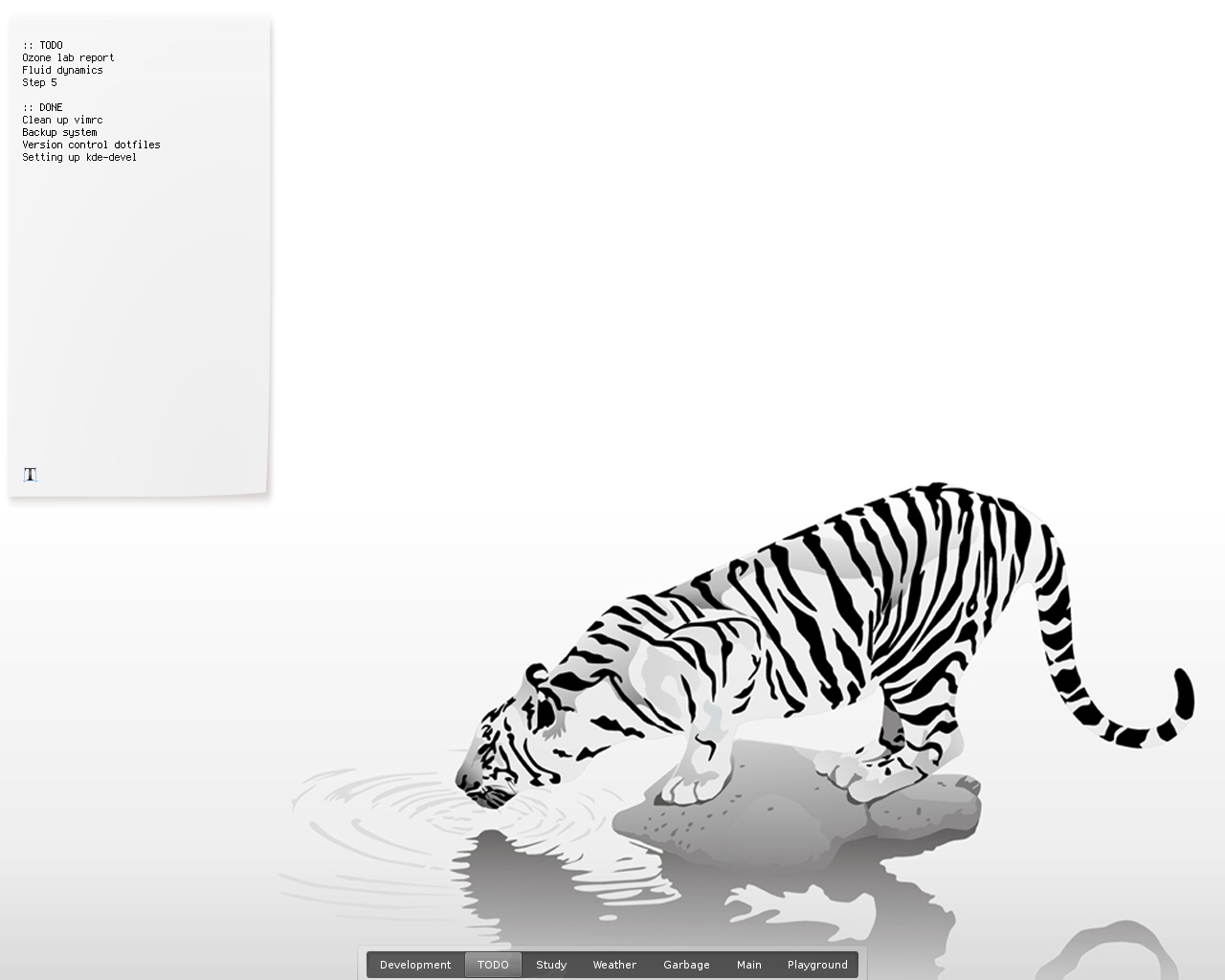
 Ever since the introduction of the activity concept in KDE Plasma Workspaces, it has caused confusion to many people. To spread some inspiration I wrote a blog post some time ago with examples of how I used activities. It ended up, much to my surprise, to be one of my most popular posts. This seemed to suggest that many still didn’t know what to use activities for.
Back then I often explained activities as ‘similar to virtual desktops, which are groups of windows, but instead activities are groups of desktop widgets’. However, in 4.6 they have evolved past this stage – now windows are also associated with activities. Therefore I wanted to write a blog post about the current state of activities, but someone beat me to it; a few days ago Jason Lim Yuen Hoe posted a very nice article on activities that brought up most of the points I planned to talk about. I found that the post reflected my own thoughts very well, and if you haven’t read it yet, I recommend giving it a read.
In this post I’ll instead write about my personal vision of how I hope activities will change my workflow. It’s based on my own experience and what I’ve read about activities. Note that it doesn’t necessarily coincide with the vision of the Plasma team, but if there are any inconsistencies I would appreciate if a Plasma developer could point them out in a comment below.
After reading this I hope that you will get a better understanding of what activities are and start to think about how you can benefit from them. I will also try to answer the frequently asked question “Why should I use activities instead of virtual desktops?” and explain when I think you should use what.
Translations: Portuguese | Russian
Read the rest of this entry »






 Who Says Penguins Can't Fly?